Approaching a house that seems perfect in design automatically makes one slow down without understanding why. Generally, there are a number of well-thought-out decisions that make this happen. It was during the process of aiding my relative in designing his façade that I learned all this. A modern house façade is not meant to be trendy; it is meant to be the perfect combination of different features including material, colors, and lighting. If the ratio is not correct, even the use of expensive material will not look good at all. This guide covers all the necessary elements required in creating a perfect modern façade, what each does, and the right way to combine them without making the house look like a show room.
What a Home Facade Does Beyond Looks
Environmental psychology research suggests people form an impression of a house within a fraction of a second, long before they reach the door. The home facade carries that impression: material, color, scale and light all work together. Architects also treat it as the building’s interface with its environment, because it controls light, insulation and ventilation while expressing the owner’s taste.
Three structural ideas matter more than any paint swatch. Symmetry between windows and doors reads as balance. Repeating two or three materials instead of five or six reads as order. Depth, created by offsetting a wall plane, adding an entry canopy or setting windows slightly back, stops a flat front from looking cheap.
Facade Design and Resale Value
Exterior upgrades consistently rank among the renovations with the best return. Industry cost-versus-value reports have put siding replacement at roughly 69 percent recouped, a new front door at over 100 percent, and a garage door replacement at close to double its cost. Exact figures vary by year and market, but the pattern holds: doors, siding and cladding repay the most.
Choosing Materials That Define a Modern Home Exterior
Material choice sits at the foundation of every successful facade. Get this part right, and everything else becomes easier to layer on top.
Mixing Stone, Wood, and Metal for Depth
A facade that consists of just one material tends to lack depth, which is vital for creating an eye-catching exterior for a house that should be modern. Brick, stone, wood, and metal work together to create depth, yet not to make the design look cluttered. Stone or stonework is always a natural element that brings some depth to the whole architectural design, especially when there are some other smooth surfaces around. Combine it with smooth siding and you’ll have a perfect mixture of materials that is considered contemporary architecture nowadays. Wooden elements can be placed near entrance points, soffits, and walls that are accentuated. Metal siding provides such an up-to-date effect to the exterior that cannot be achieved with any other materials used separately.
Stay with two or three materials at most, and make sure that one is dominant while the other two serve as accents. Stone and brick will last for decades to come, and it’s best to get those selections done accurately upfront. It’s much simpler and less expensive to change things such as the door color and lighting, which are more trend oriented. Composite materials nowadays have an uncanny resemblance to wood; you get the same effect without having to do any staining or sealing of the material.
Fiber Cement, Stucco, and Standing-Seam Metal Roofing
The flat and smooth appearance of fiber cement panels and stucco is what the modern design calls for. A standing seam metal roof will provide great durability along with a modern shape. Slate or premium composite shakes would provide both texture and durability for an elegant look. Flat or low-sloped roofs continue to be a signature feature of this style and give any home a sleek look. When remodeling an existing structure, changing the roofline can make a big difference. Even with retaining a sloped roof, combining it with clean fascias and simple trim can greatly enhance its look. It’s important to consider that roofing is often for the long run.
Siding Orientation, Brick, Stone and Specialty Finishes
Vertical siding reads taller and sleeker, horizontal siding feels grounded, and mixing both on one elevation adds interest; accent panels in a contrasting texture break up large wall areas. Natural brick is returning, especially earthy tones with warm undertones that vary across the wall instead of looking flat. Natural stone cladding ages well and picks up a rustic patina, while wood siding is warm but needs more upkeep than masonry (larch and oak last decades even unfinished). For a moody, textural look, shou sugi ban, the Japanese charred-timber technique, has gone mainstream, and Corten steel planters add warmth as they rust. These cost more upfront but age with character. In heritage areas, check local rules before changing traditional materials.
Color Trends Shaping the Modern Home Exterior in 2026
Color transforms a home’s mood more dramatically than almost any other single decision. Choosing wisely here means understanding both current trends and lasting appeal.
Warm Neutrals and Moody Earth Tones
Purely white and purely gray siding is starting to be replaced by more warm and rich colors. Colors such as creamy beige, taupe, and umber are currently dominating the siding palettes of most homes today. Deep and moodier colors such as charcoal, navy, and forest green come across as being elegant as opposed to being cool. These colors will look amazing when photographed, and they age well as opposed to trendy and vibrant colors. Sun-baked colors such as terracotta, muted coral, and golden ochre are also becoming popular with brickwork and trimmings.
Color Drenching and High-Contrast Palettes
While once only used indoors, color washing is now making its mark outdoors as well. Painting your entire house in just one color such as charcoal or burgundy creates an impact that’s hard to miss. Using high contrasting colors continues to be a surefire solution, either using light-colored sidings with black window trim, or vice versa. The addition of just one accent color finishes the look.
Choosing a Color Palette That Ages Well
Dark exterior colors such as charcoal, black and navy pair well with greenery and rarely look dated, but they fade faster, so plan on repainting every 7 to 10 years rather than every 10 to 15. Cream siding with charcoal trim is a dependable high-contrast pairing. Always test the color outdoors on the actual wall, because small swatches judged indoors give a misleading impression. Keep house numbers, mailbox and porch lights in one consistent material and color.
Windows, Doors, and Architectural Details
Beyond materials and color, specific architectural features define the modern home exterior aesthetic. These details anchor the design and tie every other choice together.
Large Geometric Windows and Black Frames
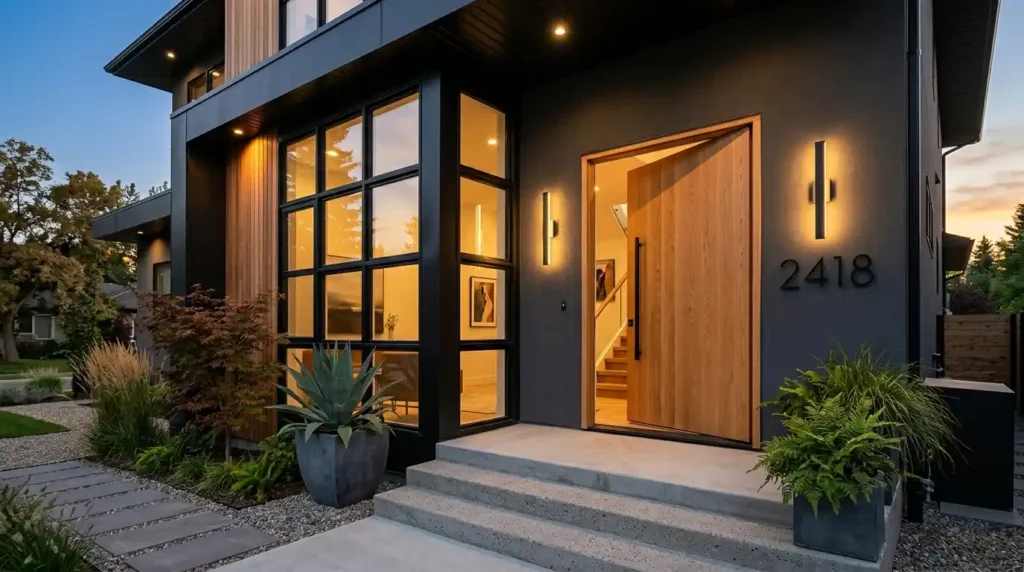
Black-framed, large, geometric windows are still very important elements of this architectural style. Such sharp contrast is emphasized against the light color of the siding, giving visual support to the whole building. Besides, large windows allow filling the interior with light.
The Front Door as a Design Statement
The current front doors have become focal points rather than just details added later on. Large pivot doors, vivid colors, and unusual materials such as glass or colored wood are great options. Terracotta or bright green door will provide a nice contrast to a sleek and plain-looking facade. It is usually the least expensive approach to spruce up the look of an old modern-style house. The change of a door from boring to something colorful or unusual will take only one weekend. Just add house numbers and a contemporary light fixture.
Extending the Modern Home Exterior Into Outdoor Living
The exterior design of a modern house does not only end with the walls but extends itself outdoors naturally. The indoor and outdoor relationship has become one of the characteristics of modern design.
Patios, Pergolas, and Indoor-Outdoor Flow
Large glass doors and sliding walls help dissolve the boundaries between indoor and outdoor spaces. A covered porch or pergola helps to create extra space and provides shade. You can ensure that the same colors used indoors match those outside, creating a unified look.
Landscape Lighting and Hardscape Choices
Uplighting trees, lighting up architectural features, and softer path lights enhance nighttime appearances. Carefully selecting hardscapes such as pavers or stone can provide functionality while still complementing the look of the entire property. One tip to remember is to avoid overly bright lighting; homes with too many lights become boring very fast. Using a warm color bulb is usually more aesthetically pleasing on the outside of a modern home rather than cool color lighting. If you are considering using pavers or stone for a walkway and your climate experiences freezing winters, ask about freeze-thaw resistance.
Smart Lighting, Permeable Hardscape and Native Landscaping
Layer path lights, wall sconces and uplighting for depth after dark, and add motion-sensor or daylight-responsive controls to save energy while keeping security. Permeable pavers let rainwater drain instead of pooling, and large-format porcelain or concrete pavers make patios and pool decks feel bigger; check slip resistance and freeze-thaw durability. Native, drought-resistant planting and xeriscaping cut water use and upkeep, and matching plant textures to the exterior palette ties the property together.
Sustainability: Solar, Efficient Windows and Water Saving
Solar shingles and panels now follow rooflines instead of sitting on top as an afterthought, and green roofs suit flatter sections. Energy-efficient windows, LED or solar lighting and drip irrigation all lower running costs, and buyers increasingly ask about them, so they support resale value as well as comfort.
Modern Home Exterior Styles to Consider
It is not always possible for modern homes to have the same appearance because of the influence of the local weather and size of the lot on their look.
Midcentury, Desert, and Coastal Contemporary
Flat surfaces, large windows, and horizontal lines are common features of mid-century modern design. Desert contemporary dwellings feature natural color palettes, flat roofs, and water-conserving landscaping appropriate for desert environments. Coastal contemporary styles are designed with light colors and durable surfaces that can withstand exposure to wind and salty air.
Small Homes and Tight Urban Lots
A large space is created even by a small house design through the use of high windows and intelligent dimensions. Contemporary urban designs take advantage of sharp angles and slim lines to make a unique design on a small plot of land. Screens, blinds, and fencing allow for sufficient light while still maintaining privacy on a small space.
Modern Farmhouse, Mediterranean and Industrial Facades
The modern farmhouse formula, white walls, dark roof, black trim and board-and-batten gables, is losing ground to sleeker contemporary and minimalist exteriors that skip barn references for geometry, glass and concrete. Mediterranean-influenced facades use stucco, stone features and sunny hues, while industrial facades revive raw brick and black metal. Minimalism does not mean fewer elements, only that each one has a purpose.
Planning an Exterior Renovation Without Costly Mistakes
Spend first on the most visible items: the front door, windows and cladding. Cheaper details such as house numbers and planters can wait. Concentrating budget on a few elements usually looks better than spreading it evenly across everything, and a front door repaint is often the cheapest change, commonly under $100. Check whether the work needs a building permit before ordering materials.
AI visualization tools can now show different materials and colors on a photo of your house, which cuts the gap between render and result. They still cannot judge proportions or structure, so involve an architect for anything complex. Common mistakes include using too many materials, ignoring local style rules, choosing color from a small indoor swatch and over-lighting the exterior.
Conclusion
An effective exterior of any contemporary house depends on correct choice of materials, bold use of colors, and integration of interior and exterior. First, consider those aspects of your design that will endure for many years, and then add those trends that can be changed effortlessly in time. And then you will have a timeless look for your house!
Frequently Asked Questions (FAQs)
The mixture of fiber cement, stucco, stone veneer, wooden elements, and metallic cladding makes a unique modern appearance.
The neutral color palette is being replaced by darker shades such as taupe, beige, charcoal, and forest green.
Black window frames provide sharp contrasts, which are well-suited for most modern exteriors.
It is important to choose an attractive front door, black window frames, and one or two good materials only.
6 thoughts on “Modern Home Exterior: 7 Design Elements That Boost Curb Appeal Instantly”