The one thing every pianist encounters in their life is that wall where the mind knows what should be done. But the fingers just refuse to listen. That was me when I was first learning how to play piano. I always thought that going faster was going to solve my problem. My way out of this problem has been learning to slow down and working on my technique all over again.
How to learn to play faster on piano does not need the constant supervision of a professional, just disciplined training.
How to Improve Piano Finger Speed and Dexterity at Home Without a Teacher
Before jumping into exercises, it helps to understand what actually builds speed and dexterity in the first place. Rushing straight to fast playing usually backfires.
Why Technique Matters More Than Raw Effort
Finger dexterity for the piano comes first in terms of technique because this is the basis for all other aspects such as speed. Practicing the scales with proper finger placement helps prepare for future rapid and flawless pieces. Posture is also crucial to play the piano because sitting straight with the back straight on the front part of the bench is important in order to keep the right alignment of arms and hands. Being slouched or sitting too far away from the keyboard negatively influences natural movements of wrists and forearms which prevents one from playing quickly and smoothly.
Most piano players try to go for speed before they have mastered these skills and are surprised that their performance is suffering because of that. Knowing how to increase finger speed and improve dexterity on the piano will be learned through these fundamental skills, not fancy finger exercises. When you feel comfortable with your techniques, speed will become a result of repetition and not something that you need to push. And this change of perspective only made my whole process of practicing completely different. Speed was not my priority; I worked on clean movements first and achieved good speed in a few weeks.
Warming Up Before You Even Touch the Keys
A warm-up of your fingers, hands, wrists, and shoulders readies you physically to practice and minimizes any chances of straining yourself. This can be achieved through some simple stretching exercises that promote circulation before sitting at the piano.
Stretching and No Equipment Finger Exercises
You don’t need any special equipment to start building genuine finger strength and independence. A few simple movements, done consistently, deliver real results.
Finger Taps and Isolation Drills
Press your palm on a table or flat surface and raise each finger in turn without moving your other fingers. This isolation technique is useful in developing finger independence, which is the ability of individual fingers to act independently of the rest of your hand, since fingers that have not been trained are used to acting simultaneously. Tap each finger to the beat, using a metronome if possible, to develop timing along with independence. A few minutes of daily practice will improve your control in a matter of two weeks. Concentrate particularly on your ring finger and pinky, which are usually weaker than your other fingers.
Stretch and Fist Curl Routines
Extend the hand and spread the fingers as far apart as you can. Now curl your fingers into a soft fist and then uncurl. Repeat this several times for each hand. Stretching is also required for the thumb, where you need to stretch the thumb away from the other fingers, hold for a moment and return the thumb to a natural position. This stretching should be done daily, including those days when you don’t have practice. It takes only minutes to do it and is an excellent daily routine.
Scale, Arpeggio, and Metronome Based Drills
Once your fingers feel warmed up and independent, structured drills build the technical foundation for actual speed. These exercises form the backbone of most serious practice routines.
Five Finger Patterns and Full Scales
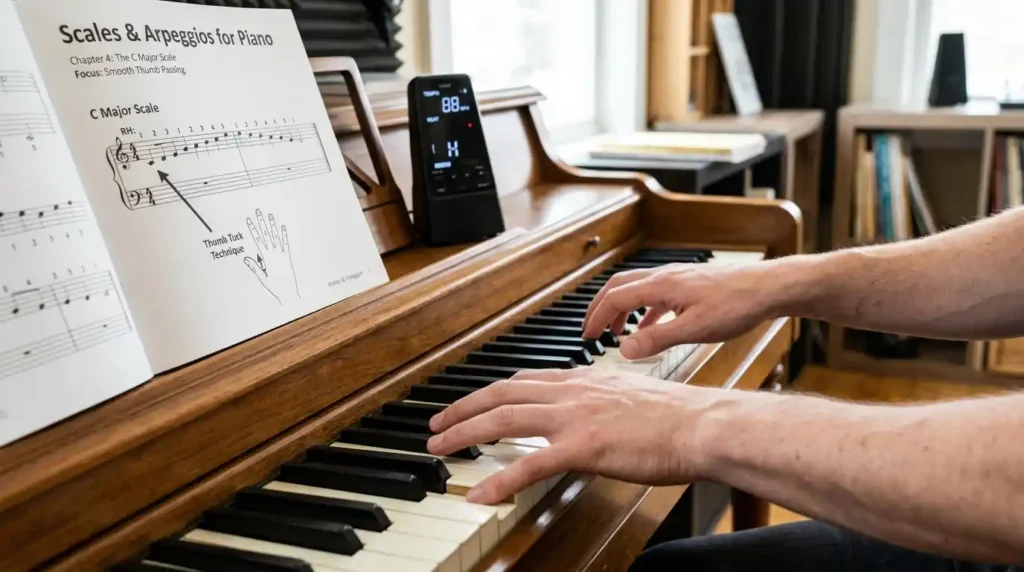
Begin with basic five-finger scales, consisting of the first five notes of any major scale moving up and down. Work on getting even notes, with each one being played evenly loud and even in timing. Then move on to full scales using more than one octave, while making sure that everything is done with the help of the metronome. It is important to gradually pick up the pace only after achieving success with playing something slowly. One of the most common errors that pianists tend to make in their quest for speed is rushing through this process.
Arpeggios and the Thumb Tuck
Arpeggios, which are basically broken chords, bring another technique known as thumb tuck into the picture where you tuck your thumb under your palm in order to continue to the next octave. Start out slow with this technique and keep your hands flat and loose, not tight. Exercises such as those from Hanon or Czerny are designed for developing exactly this type of finger dexterity. Many people who play piano actually include several minutes of Hanon and Czerny in their daily routine just for this reason.
Building Speed Without Sacrificing Rhythm
Raw speed means little if your timing falls apart under pressure. This final piece ties everything together into genuinely useful playing.
Practicing Weak Fingers and the Non Dominant Hand
Most piano players have one hand that is obviously weaker than the other, which is the non-dominant hand, as well as weaker fingers such as the ring finger and the pinky finger. Focusing on these weaknesses during practice ensures you have more balance in your technique. It does not mean that you should neglect practicing on your stronger hand; rather, you should adjust the proportion of your practice to accommodate any weakness that you might be having.
Slow Practice, Repetition, and Muscle Memory
Real speed comes from a lot of repetitions in order to build up muscle memory through consistent and correct practice. Practicing a complex section slowly and correctly, many times, would lead to the development of fast and accurate performance skills. One needs to keep in mind that speed is only useful in the context of rhythm.
Conclusion
Improving one’s skills and abilities in improving the speed and dexterity of playing the piano from home is all about regular stretching, training, and practice. Work on technique first, work on your weaker fingers and weaker hand, and always practice using a metronome. If you keep doing that, you will see steady improvement in the future.
Frequently Asked Questions
What is the period that I need to improve my fingers’ ability?
There have been many people who have experienced great improvement in their playing after only one or two weeks of practicing, but it requires more time to achieve a certain level of perfection.
Is it necessary for me to have a piano to do finger exercises?
Not really, as there are many exercises that require nothing more than just a surface, like a table, to perform.
Can I practice slowly if I want to play fast later?
No, you should always begin with slow movements until you learn how to play a certain section correctly.
What frequency should I use for doing finger exercises?
Just 5 to 15 minutes a day will suffice in order to make noticeable progress regarding finger dexterity and strength.