Being inside a messy darkened room has a distinct experience to being in a bright and orderly one. Well, kind of. Yes, there is the psychological effect, but there is also an actual physical effect. The knowledge about interior designs effects on mental well being gained through reading articles from mintpaldecor. And other interior design resource websites is something useful for us all.
At least it’s proven by the experience I got after clearing out my own space. And the scientific explanation of that experience makes the results even more convincing. In this guide, you will find information about the particular elements of interior design with scientific background.
Understanding How Interior Design Affects Mental Well Being Through Mintpaldecor and Similar Guides
Before changing anything in your space, it helps to understand why design choices affect mood at all. This isn’t simply about taste or aesthetics.
The Science Behind Space and Emotion
Environmental Psychology investigates people’s interactions with the environment, and the results of studies seem to be rather similar. The nervous system is constantly analyzing the room for signals of safety, predictability, and comfort, sometimes subconsciously. Such factors as light intensity, spatial arrangement, contrast, and even ceiling height are being analyzed during the process. Poor lighting has been found to affect circadian rhythm adversely. Whereas excessive visual stimuli increase the load on cognitive functions and result in stress. However, proper lighting and space arrangement are among factors that seem to reduce stress reactions according to multiple studies. It should be mentioned that in most cases. The correlation between environmental factors and stress response is not proven but rather assumed.
Despite all of this, the pattern seems to be reliable enough for designers, psychologists and architects to take it into account increasingly often. I know several people who have discussed their home environments during therapy sessions, highlighting how closely our surroundings and mental well-being can be connected. However, while a thoughtfully designed space may support emotional wellness, it should never be viewed as a substitute for professional mental health care when it is needed. It should rather be seen as one of many factors complementing treatment, if necessary.
What Design Focused Resources Get Right
Designers of spaces that have a focus on interior designs for wellness include some common factors like natural lighting, minimizing clutter, and using colors wisely. These factors are congruent with those suggested by environmental psychology studies, despite being presented in layman’s terms.
Light, Color, and Their Psychological Impact
Two of the most immediately noticeable design elements are light and color. Both carry genuine psychological weight beyond simple visual preference.
Natural Light and Circadian Rhythm
Being exposed to natural light enables the body to maintain the circadian rhythm, which controls sleeping and waking cycles and mood swings. Research indicates that rooms with minimal amounts of natural light are prone to increased instances of depression and exhaustion. There is nothing too difficult about adding plants around the windows to allow more natural light into the room. Another easy fix involves moving furniture near the windows.
Color Psychology in Everyday Rooms
From studies conducted on color psychology, it is known that colors like blue and green are likely to be more relaxing than colors like red and yellow, which are more stimulating. Even though these perceptions of colors may vary across different people due to cultural differences, it is a good idea to use relaxing colors for bedroom settings and stimulating colors for offices.
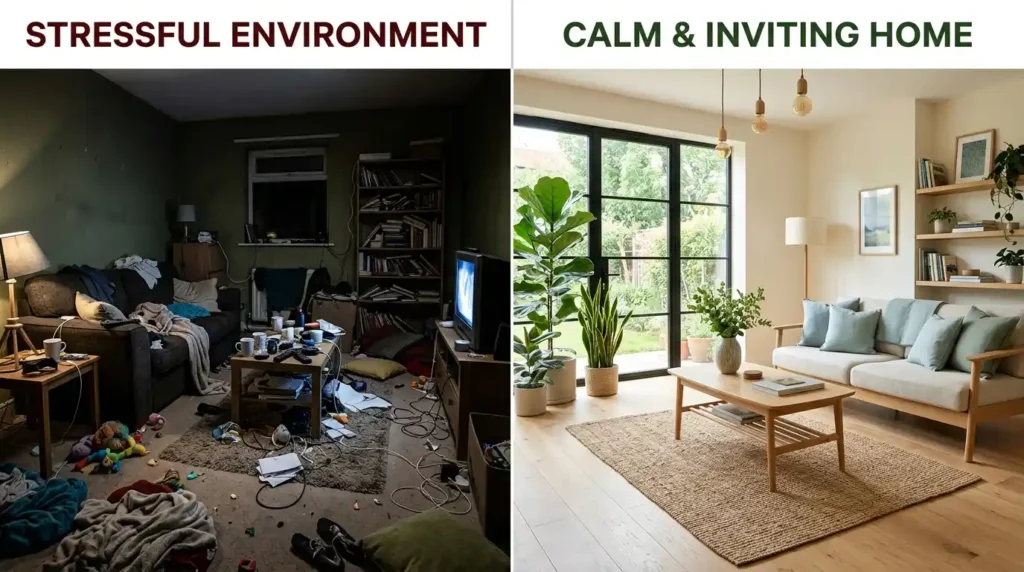
Clutter, Layout, and Cognitive Load
Beyond light and color, physical organization and room layout carry real psychological weight. This is often the easiest area to improve without spending money.
Why Clutter Raises Stress
A visual mess creates a situation whereby your brain is bombarded with much more information than would be the case with a neat environment, thus causing what psychologists refer to as a high cognitive load. This extra strain may result in people being less focused, stressed or tired at the end of the day. Simply organizing one surface in the house, such as a kitchen countertop or entryway table, will create a significant relief. Organizing systems that put things away, as opposed to just hiding them elsewhere, are the most effective in the long term. Examples include baskets, closed cabinets and clearly labeled bins.
Spatial Layout and Sense of Control
Open spaces might invite socialization, whereas a small defined space can provide the feeling of a retreat or privacy. Clearly arranging furniture to create dedicated zones for work, sleep, and play helps separate daily activities, making it easier to stay organized, focused, and mentally balanced throughout the day. A family that I know remodeled an open layout to have more defined areas in their home, and now their children use the play area rather than leave things everywhere.
Biophilic Design and Sensory Comfort
Beyond visual elements, our other senses shape how a space feels too. Biophilic design and sensory comfort round out a genuinely holistic approach.
Bringing Nature Indoors
Biophilic design involves the inclusion of natural materials such as plant life, wood grains, and flowing water inside interior spaces. Research has demonstrated that hospitalized patients who have natural views are capable of recovering at a faster pace compared to those without them; moreover, natural lighting and plant life have been proven to enhance the performance of students in some classes. Even a few house plants are enough to bring about a touch of this concept indoors. In cases where living plant life is too much effort, fake greenery or even photographs of nature might do the trick.
Texture, Sound, and Material Choice
The softer textures of natural fibers and wooden tones are typically more soothing than harder, colder, or more reflective materials. It is also important to consider acoustics because high noise or echo levels can cause stress even without our conscious awareness of what’s causing it.
Practical Steps to Apply These Principles at Home
Understanding the theory is one thing; applying it affordably is another. A few accessible changes deliver genuine impact without a full renovation.
Small Changes That Make a Real Difference
Begin by clearing out one room at a time, increasing the amount of natural light that enters the space, and adding one or two plants. These small actions do not take much money, yet they always come back up in studies as factors that contribute to making an environment more peaceful. Soft lighting in the evening is another important factor because too much overhead lighting during night-time hours becomes disturbing.
When to Consult a Professional
For bigger projects, there is the option of hiring an interior designer who is knowledgeable about such wellness-centered approaches. In the case where one is struggling immensely with mental well-being, the change should be combined with therapy by a licensed professional.
Conclusion
The influence of interior design on mental health as explained by mintpaldecor and other such sources that deal with wellness – is not about being trendy; it’s about putting psychological principles into practice through design. Light, colors, clutter, and the presence of nature are just some of the factors that have an impact on the emotional experience of a space.
Frequently Asked Questions
Will redecorating my home help my mental well-being?
A carefully designed environment can help decrease stress levels and boost your mood, but only as a complement to mental health care rather than a replacement.
Which simple change is going to be most helpful for psychological purposes?
Cleaning out one room and making sure that there is enough access to natural light would be the easiest changes.
Do relaxing colors indeed have a calming effect?
Colors such as blue and green are considered relaxing; however, associations play a role in individual reactions to colors.
Is biophilic design only about adding some plants?
Apart from the use of plants, it also involves elements like natural lighting, wood, water, and other natural materials.