One time, I spent an entire weekend trying to find a rug large enough to ground my giant sectional. But found out that all their collections end at 9×12. Such frustration is actually very common. Considering that larger rugs like 12×15 living room area rugs solve the problem of sizes that smaller ones cannot provide.
They provide sufficient coverage in terms of floor space and make the room feel more unified. Without the furniture having to stand alone on the exposed floor. In this article, you will learn the specifics of such rugs. And how they should be placed and the type of material that would be best suited for a living room setting.
Why Large Area Rugs for Living Room 12×15 Spaces Are Worth Seeking Out
Standard rug dimensions generally fall quite far short of being suitable for really filling up a large room. When you have purchased your sectionals or formal living rooms, or even just your great room. A smaller rug will likely make your furnishings seem disjointed from their surroundings. The reasons why become clear once you realize what the greater dimension is capable of offering.
How Much Floor Space a 12×15 Rug Covers
The 12 x 15 rug has an area of 180 square feet. Which equals 360 by 450 cm or about 16.7 square meters for those using metric units of measurement. This is a much larger area compared to the 9 x 12 and 10 x 14 rugs. Which may result in large furniture pieces extending past the edge of the carpet. Rooms with large furniture sets or open-floor plans will greatly benefit from a rug of such dimensions.
Why This Size Is Harder to Find Than 9×12
The usual size limit that most common rug collections come to is about 9×12 or 10×14. With anything larger becoming difficult to find. It becomes quite costly both to manufacture and ship these sizes, making them rarer in availability by regular merchants. These large rug sizes are sometimes called “mansion-size” rugs in the rug business. 12×15 rugs usually can be found only through large-format rug retailers. This will make the search easier because you already know what to look for unlike with ordinary rug collections.
Getting Rug Placement Right
Correct placement determines whether your rug pulls a room together or leaves it looking disjointed. A few consistent guidelines take much of the guesswork out of this step.
The Furniture Legs Rule
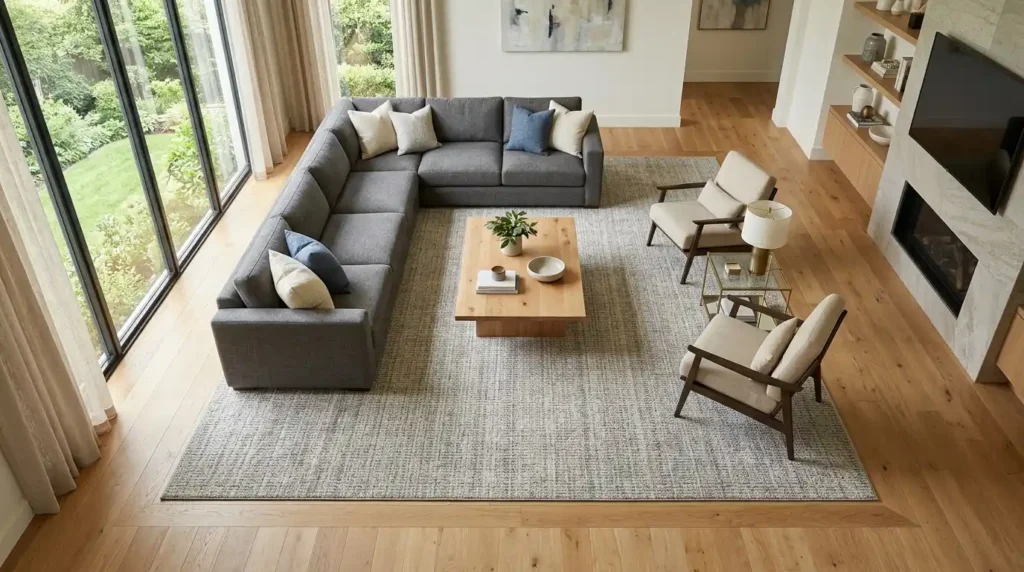
To achieve a balanced appearance. It is important to make sure that all large furniture items at least have the front two legs on the rug. For larger living rooms. Placing all the legs of your seating furniture on the rug creates a more cohesive, balanced, and polished appearance. This principle is also applicable to the dining area. Where chairs need to be positioned completely onto the rug even if they are moved from the table. Not doing so is the most frequent error made by people.
Leaving the Right Amount of Visible Flooring
As a rule of thumb, it is recommended to ensure there is a visible border of flooring. That is twelve to eighteen inches wide between the rug’s outer edge and the wall itself. This will keep the rug from appearing to be a wall to wall carpet. Yet still give it plenty of coverage. It is important to remember that if you have a rug pad underneath your rug, it must be an inch or two shorter on all sides.
Material and Construction Choices
Construction method affects both price and durability considerably, so understanding the differences helps you shop with realistic expectations. Not every large rug is built the same way underneath its surface pattern.
Hand Tufted, Hand Knotted, and Machine-Made
The hand-tufted rug is done by shooting the yarn through a canvas base with a tufting gun, thus providing a moderately priced product between machine-mades and fully hand-mades. The hand-knotted rug, on the other hand, is hand-tied and is therefore expected to be more durable and heirloom quality as there will be fringes showing at both ends. The machine-made rug is done on an automated loom, hence the cheapest and easiest rug to obtain in this bigger size. It is therefore important to know that these are different pricing points in order to have realistic budget expectations.
Wool, Jute, and Synthetic Fiber Comparisons
Wool carpets, especially those woven from New Zealand wool, are known to be very soft and durable enough to withstand any kind of day-to-day wear and tear. Jute provides a natural texture but is better suited for rooms which have less moisture content. The man-made rugs, polypropylene and recycled PET, are more resistant to stains and fading. Ultimately, the selection of material depends on the amount of wear that your living room receives.
Beyond the Living Room: Other Uses for This Size
Though this guide will concentrate mainly on how to apply the rug to the living room, a 12×15 rug works great in a number of places as well. It is good to know these other uses in case you are furnishing multiple rooms at the same time.
Dining Rooms and King Size Beds
For use in a dining room setting, such a rug is adequate for accommodating a dining table that can hold eight to ten people without leaving the chairs off the rug when pushed away from the dining table. When placed below a California king-size bed, this rug will provide more coverage around the bed in the main bedroom.
Open Concept Zones and Outdoor Spaces
An open plan design is highly advantageous in its capability to use a big rug for defining a lounge, dining or media area in an uninterrupted space. This is an effective strategy not only in terms of minimizing echoes in rooms with a hard floor but also in tying the entire decoration scheme into one whole. This type of rug in outdoor rating can be used on porches or patios.
Choosing the Right Rug for Your Room
Not all rooms need the largest size possible; rather, it is important to ensure that the choice of the rug matches your particular room. There are just a couple of things you have to be true about.
When a Smaller Size Actually Works Better
In order to enhance the appearance of smaller rooms, it is advisable to go for a 5×8 or 6×9 instead of choosing a massive rug, which may ruin the look of the room. Living rooms that are reasonably balanced and sized may be ideal for an 8×10 or 9×12 rug.
Care and Maintenance Considerations
Washable machine choices have gotten more common for those looking for coverage on a larger scale without the care required by intricate handmade pieces. Cleaning the piece often and treating spots quickly is sure to keep the longevity of the rug no matter what it’s made of. Looking at your home needs realistically will allow you to pick out the right type of construction.
Conclusion
The proper choice of size, materials, and design elevates a spacious living room from merely having furniture into truly being complete. Large rugs for living rooms of 12 x 15 measurements are a solution to the problem that arises from the fact that other rugs are not big enough for an excessively spacious living room. Measure your space, choose a suitable construction technique and do not hesitate to look beyond conventional stores for this relatively rare rug size.
Frequently Asked Questions
How many square feet is covered by a 12×15 rug?
A 12×15 rug provides 180 square feet of coverage, or about 16.7 square meters, and thus is much bigger than a regular 9×12 or 10×14 rug. It is perfect for oversize sectionals and formal living rooms.
Why is a 12×15 rug less available than other rug sizes?
Mainstream rug collections end their sizes at 9×12 or 10×14, because it becomes expensive both to manufacture and ship rugs of bigger sizes. You have to look for specialty large format rug sellers.
Do you have to place all furniture legs on a 12×15 rug or only a few?
Both approaches are acceptable, but having the front legs of all major furniture pieces on the rug makes the overall look more coherent. In larger spaces, you can fit all furniture legs completely on the rug.
Is a 12×15 rug too large for a small living room?
Yes, if your room is rather small or cozy, 5×8, 6×9 or 8×10 rugs should be proportionate to the room size. You should use 12×15 rug only in bigger rooms.