The days when building your own home security system consisted of several motion detectors and many false alarms due to cats or windy weather have passed. The technology has developed significantly, so modern cameras distinguish between a delivery man and an intruder. And this brings up a very clear question in connection with your first DIY home security system machine learning project.
In simple terms, it is the very technology that allows your camera to learn certain patterns rather than react to any movement. Here you will find information about the processes of learning, features based on it, as well as construction of a smarter system despite the lack of knowledge in the field of computer science.
DIY Home Security Systems What Is Machine Learning in Practice
Before diving into specific features, it helps to understand what’s actually happening behind the scenes. Machine learning isn’t magic; it’s a set of trained patterns applied to your camera’s video feed.
How Cameras Learn to Recognize Objects
The essence of machine learning in the case of a security camera lies in its neural network. In particular, almost all cameras use convolutional neural networks to analyze an image through decomposition into visual features. These are analyzed using the data related to shape, movement, and spatial location, compared to the thousands of images that the system studied in training. It gradually becomes more and more proficient in distinguishing people from swaying branches and raccoons. This is precisely why answering DIY home security systems what is machine learning is important for amateurs.
Models which have already been pre-trained, i.e., models that have been trained on a very large data set, mean that the hobbyist need not worry about the hardest part of all. One does not need to train the camera to recognize what a person looks like; rather, one takes an existing model and tweaks it slightly for their particular environment. This is all done by object detection tools automatically, as the objects are classified within each individual frame.
Why This Matters More Than Simple Motion Sensors
While traditional motion sensors detect any motion, nothing more, machine learning-based sensors provide contextual information about what is happening and help to differentiate a person coming to your door from a flying plastic bag on your lawn. This is very important once you get used to receiving notifications each time a moth crosses the viewfinder. Filtering the number of false-positive alerts becomes the primary benefit of such technology for a lot of hobbyists who upgrade to better devices. Besides, there is no doubt that users will be more willing to check out the received alerts if the majority of them are relevant.
Building Your Own AI-Powered Security Camera
If you can grasp the basic technology, putting the whole thing together becomes much easier. There are several simple tools available that will help you get this done.
Hardware You’ll Actually Need
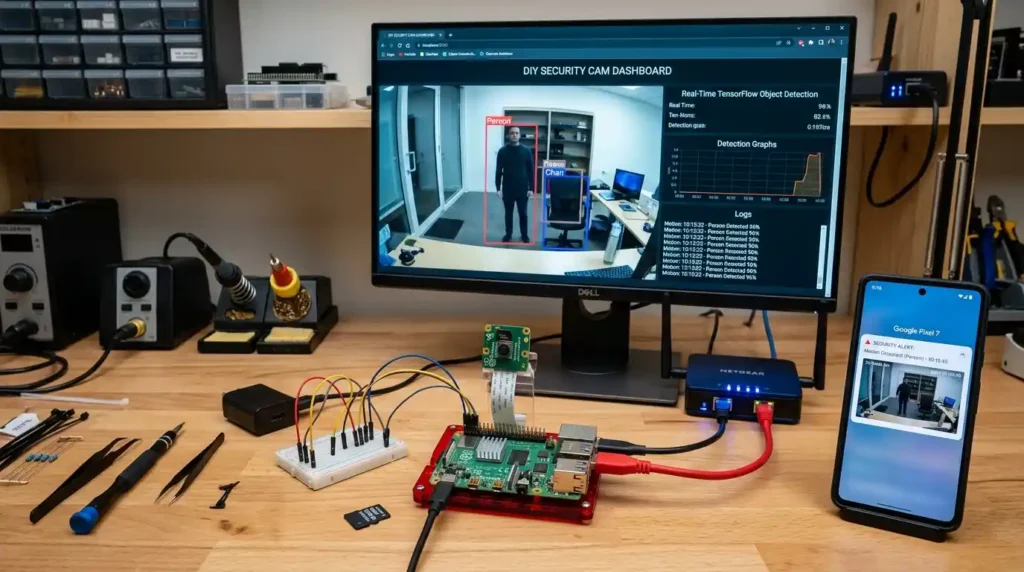
The vast majority of Do It Yourself systems begin with a Raspberry Pi a compact and cheap computer able to run lightweight machine learning models. Add a Pi Camera module or even a reused smartphone camera to it to create videos. For example, one of the well-known projects was created by the developer Bofu Chen who combined his Raspberry Pi with an open-source platform called BarryNet in order to keep an eye on his house. This solution made it possible for him to teach the model to distinguish particular individuals or things that appeared on the screen.
The laptop or the desktop computer running Ubuntu usually performs the heavy processing, while Raspberry Pi computer cannot cope with it on its own. The choice of the camera is also important as not all WiFi cameras will work with the open source solution. Sadly, there are companies whose cameras are locked into their proprietary cloud-based solutions and cannot be connected to any other software at all. But before purchasing a camera, one should make sure it is compatible with such IP protocols as it makes the usage of programs such as MotionEye possible.
Software Frameworks That Power Detection
OpenCV still stays the most commonly used library for dealing with computer vision problems such as object detection and image processing. Combine OpenCV with TensorFlow or PyTorch, both of which are popular ML frameworks, for executing the detection models. Python serves as a universal connector here, as most of the mentioned above tools have been developed using Python. As for the notifications, the majority of enthusiasts use Telegram, Pushover or even a simple Flask web server. This way you will get an instant notification on your mobile device when the system finds something interesting.
Comparing DIY Builds to Commercial AI Security Systems
Building a system from the ground up isn’t the right choice for everyone, and that’s perfectly understandable. Commercial options offer polish and support that DIY setups sometimes lack.
What Off the Shelf Brands Offer
These firms offer consumers machine learning capabilities in convenient bundles. The most common include facial recognition, intelligent locks, climate control integration, and all controlled via an app. ADT has focused on combining facial recognition with smart lock integration to provide comprehensive whole-home security. Canary has concentrated more on climate monitoring as well as detection capabilities. In addition, Ring has remained popular mainly due to its affordable plans and numerous users already using it. The drawback, however, is normally a subscription fee and having little say about where your video footage is stored. For many users, however, such services outweigh any trouble that might arise when working with hardware.
When a DIY Approach Makes More Sense
For those who prioritize privacy, hosting their own system ensures that there is no upload of videos to the cloud server of any third party. DIY systems also allow for customized setting of rules rather than what an app can do. This might involve some difficulty initially, but in the long run, it’s worth it.
Reducing False Alarms and Improving Accuracy Over Time
Even a well-built system needs ongoing refinement. Machine learning models genuinely improve when you feed them feedback about what they got right or wrong.
Training Your System With Feedback
There are many clever camera devices that allow users to mark detections as true or false. This is used to improve the underlying model and minimize false triggers from pets, shadows, or even moving trees. In some cases, learning happens locally using the technology known as edge AI, while in other cases, the footage is sent to cloud-based servers where more sophisticated analysis takes place. The edge-based solution responds faster and provides more privacy because the footage doesn’t leave your premises. However, it’s likely to be less accurate, as the cloud-based one has access to much more computing power. Usually, you will have to choose one approach depending on your preferences either speed and privacy or accuracy and convenience. Some enthusiasts find a way out of this dilemma by performing initial detection locally and then sending suspicious clips to the cloud for further review.
Conclusion
Having knowledge about DIY home security systems and understanding what machine learning is, will provide you with the necessary background to develop a really smart system beyond simple motion detector system. The technology used in Raspberry Pi and professional systems is the same. Begin with the smallest steps and learn how to avoid false alarms first.
Frequently Asked Questions (FAQs)
A bit of Python programming knowledge may help; however, many trained models and tutorials will assist in making it easier for beginners.
Machine learning is a type of artificial intelligence technique that does not rely on pre-programming but instead learns from the data.
Yes, it does, particularly when using small trained models. However, a paired computer often does better in more complex processing tasks.
Privacy and customization capabilities are the two main benefits as they offer more control over what happens to the video and detection criteria.