Constructing a home in the conventional way in New Zealand may take well over a year. When one considers the designing, planning and building processes. This is precisely the reason why more and more people in New Zealand are opting for kitset homes. Whenever someone embarks on research to find out how much time the construction of a kitset home will save. All they want is the simple and straightforward answer: how fast is it really and what goes into the process? Several people that have gone through the process of building their own homes have been able to shave off almost half the time spent on conventional construction just by opting for a kitset over a custom one.
This article gives a clear definition of kitset homes. The construction time involved and how one can actually reduce or increase the time of the process.
What Makes Time in New Zealand DIY Home Kits Different
Before comparing timelines, it helps to understand what a kitset home actually is. This isn’t the same as buying a fully finished, ready-to-move-in house.
How Kitset Homes Actually Work
Kitset house is delivered to you as a package of precisely cut structural elements: frames, roofs, windows, and doors, meant for self-assembly. You basically buy all the building materials and assume the project management duties yourself, similar to putting together flatpack furniture, but on a larger scale. Special instructions, labeled materials, and even training videos will be supplied by companies. Depending on how well a builder is familiar with construction, he or she may undertake assembly on his/her own.
Another option is to hire a build team, either independently, or recommended by a company. This is exactly why timeframes differ greatly from one project to another. An enthusiastic DIY builder, who builds the house on weekends. Will most likely spend much more time than a hired team of builders who will do it professionally. In any case, opting for a kitset instead of a custom-built house may cost you 10-20% less on average.
Such savings are frequently accompanied by actual time savings as well. As materials come prefabricated and assembled as opposed to being ordered piece-by-piece. An off-site fabrication process, also known as OSM, involves construction of parts in a factory setting prior to transporting the components to the job site. The process mitigates the typical delays caused by weather and material shortages in the case of conventional construction. Knowledge of such a process should actually be the foundation. When comparing time involved in New Zealand do-it-yourself home kit compared to that of an architectural custom-build house. It is worth adding that prices for kitsets will depend on whether certain items are included in the package such as joinery, fittings, and prefab kitchen.
Consent, Compliance, and Building Codes
Nevertheless, all kit homes have to comply with the New Zealand Building Code. And in addition to that, all building consent will be necessary for most projects. The only exception is the recently adopted rule. According to which a granny flat can be built in the area of up to 70 sq. m. without any consent at all.
Realistic Timelines for Building a Kitset Home
Timelines depend heavily on project size, your own involvement, and how prepared your site is beforehand. Understanding each stage helps set realistic expectations from day one.
The Five-Stage Kitset Process
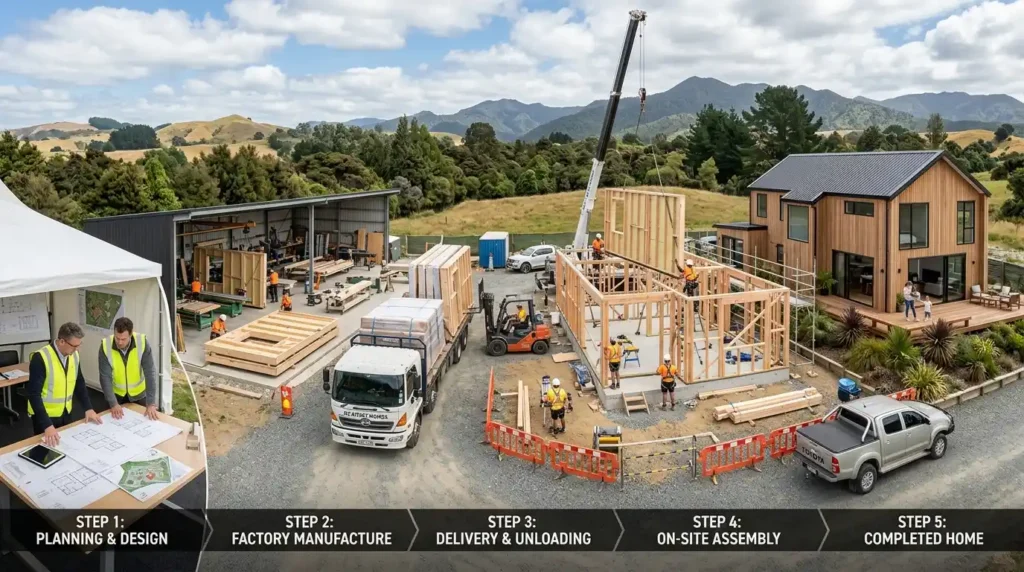
The majority of businesses adopt a standardized process of five steps: discovery, quotation, finalizing plans, staged deliveries of components, and assembly. During the discovery phase, your needs and site requirements are determined before anything is bought. After the plans have been made final, it is possible to make a building consent application during the production period. In this case, components will be delivered in the order of need rather than all at once on your site. Assembly times will differ greatly depending on the size of the structure; a small sleep-out will take several weekends whereas a whole house may require several months. A large and complicated house that will include customizations will certainly require much more time than a simple design.
Weather Windows and New Zealand’s Building Seasons
The climate in New Zealand affects how construction takes place. Generally, spring and summer seasons give you the best chance of having smooth conditions during construction. Building in winter may take much longer since storms and rains will probably hinder exterior construction activities. There is also a variation in terms of regions, where coastal areas experience more winds, but temperatures vary greatly in inland areas. It is always important to talk to the kitset provider regarding expected time frame of construction in the particular region.
Choosing the Right Kitset Home for Your Timeline
Not every kitset home suits every timeline goal. Matching your project type to your available time and skill level prevents frustration later.
Tiny Homes and Sleepouts for Fast Builds
Builds using tiny houses and sleepouts, usually from 5 to 29 square meters, can be done the quickest. Such small buildings will be the most appropriate for a weekend do-it-yourselfer who will need much less expertise than building a regular-size house. Kitset companies that build such small kitsets are known to have much quicker turnaround times than when building a regular-size house. The construction of a sleepout or granny flat may also be seen as an opportunity to practice a kitset method and check whether the kitset approach suits one for building a larger house later on.
Full-Size Homes and Custom Designs
Kitset houses of full scale and with 3 or 4 bedrooms, obviously, take more time to coordinate and complete. Such elements as prefab kitchens and custom joineries will take extra time and money to incorporate. If time is crucial for you, opting for a standard design scheme will ensure that the construction proceeds faster than a customized one would. There are some manufacturers who offer just a few approved designs for the reason that it is quicker to approve and construct them than to make something completely custom.
Budgeting and Preparing for a Faster Build
A smooth timeline depends on more than just the kitset itself. Preparation before materials even arrive makes a measurable difference.
Site Preparation and Foundation Work
Doing all the groundwork before receiving your kitset will make sure that there are no delays when the materials arrive. Ensure that there is accessibility to the site by the delivery trucks because sometimes, difficult sites delay the process. Utility services such as electricity and water should be sorted out before starting the assembly process, since doing it afterwards causes more difficulties.
Working With Experienced Builders
It is even true for skilled DIYs, who can consider employing assistance in technical construction phases such as foundations or plumbing. Various companies provide assistance to complete some construction phases, leaving the easier ones to the customers.
Conclusion
When it comes to considering time as an important element when constructing DIY homes in New Zealand, it boils down to the size of the project, how much input you have into the construction and how much preparation you make ahead of time for the building site. The truth of the matter is that kitset homes do provide the quickest and most cost-effective route to home ownership than custom-built homes.
Frequently Asked Questions (FAQs)
A small sleepout will take a few weekends, whereas normal-sized houses could take a number of months depending on size and how involved you are with the project.
Yes, many businesses claim 10 to 20 percent savings against conventional building.
In most cases, yes, but new regulations allow for no consent for “granny flats” up to 70 square meters provided that conditions are met.
Yes, particularly if you are considering a small-scale project like a sleepout, but more complex homes might require professional assistance for some parts.